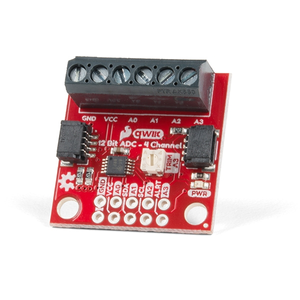
Running out of analog pins on your microcontroller is a common problem, and the SparkFun Qwiic 12-Bit ADC is the simple, reliable solution. Built around the Texas Instruments ADS1015, this board adds four channels of I2C-controlled analog input to your project, configurable as four single-ended inputs or two differential pairs. To ensure you get the most accurate reading possible, the chip features a programmable gain amplifier (PGA). This allows you to "zoom in" on very small changes in analog voltage, adjusting the full-scale range from ±6.144V down to ±0.256V. This flexibility ensures you maximize the 12-bit resolution regardless of your sensor's output range. Secure Connections and Easy Setup We designed this board for ease of use in the field. Unlike many breakout boards, this unit features screw terminals on all four input channels, allowing for secure, solderless connections to your voltage sources. For quick testing, we've also included an onboard 10K trimpot connected to channel A3; it's perfect for initial setup and verification, and can be disconnected via an isolation jumper when you're ready to use the channel for your own sensor. Utilizing our handy Qwiic Connect System, you can connect the board to your microcontroller in seconds without soldering. Need more inputs? The board has an address jumper to select one of four unique I2C addresses (0x48-0x4B), allowing you to daisy-chain four boards for a total of 16 channels on a single bus. If you need to use more than sixteen ADS1015 ADCs, consider using the Qwiic Mux Breakout.